

Behind the scenes: aesthetic

I am hoping to write behind-the-scenes posts for the poems I publish as part of The 100 Poems Project.
In this post, I’ll discuss the following poem:
The approach and break down
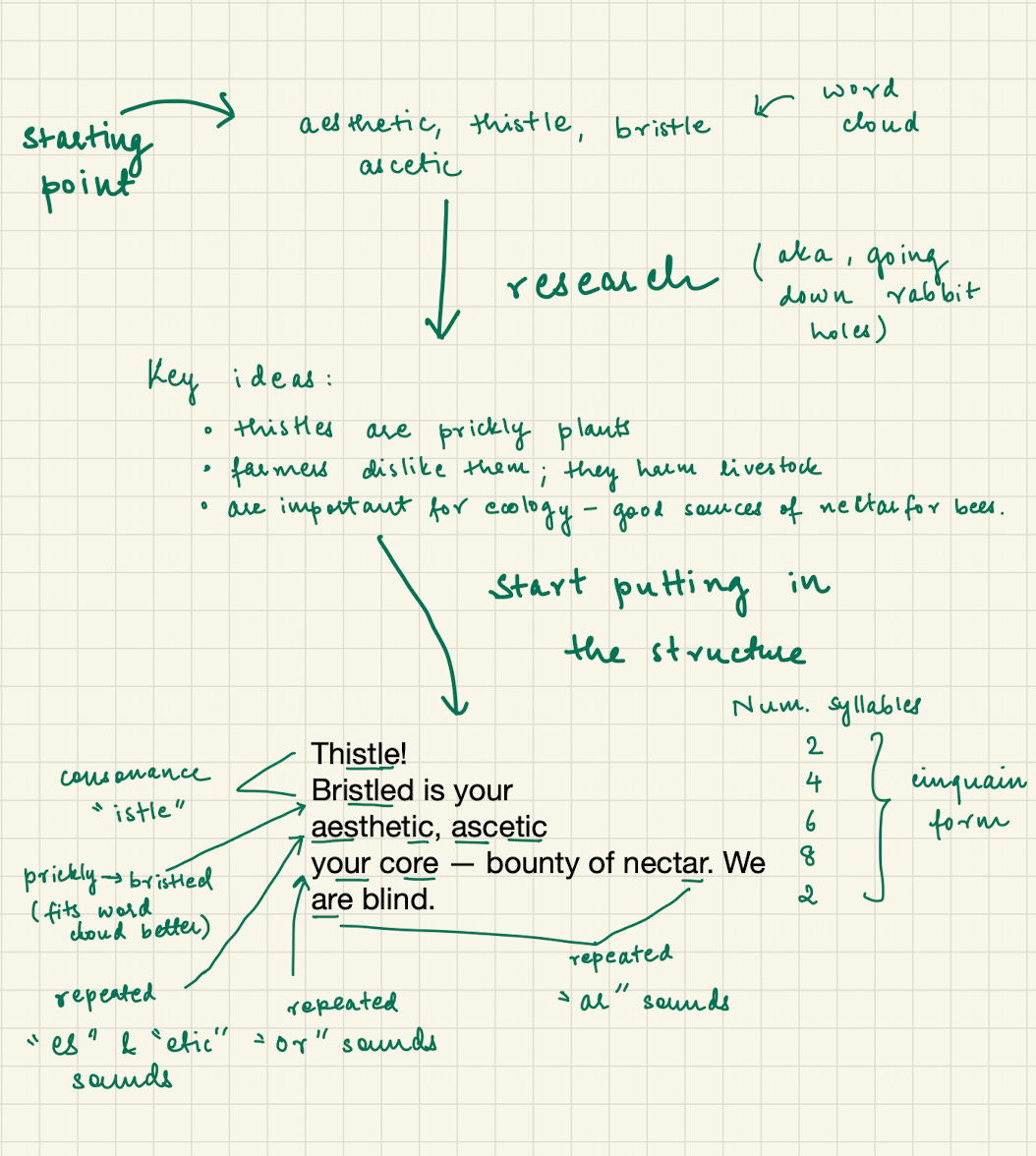
Starting from the word “aesthetic”, I began writing a word cloud. This is a technique I learnt from a poetry writing course I took a few years ago, where you let your mind form word connections based on sounds (more general than rhyming). Once there are enough words on the page, you may start to, then, also see connections in the concepts represented by those words, which may inspire ideas. I started with just two words: aesthetic and thistle, and kept coming back to add to it, as more ideas occurred to me in the next steps.
I, then, went down several rabbit holes, reading about word etymologies, about thistles and how they are good for nectar, but farmers dislike them as they can harm livestock. I read about aestheticism: a movement which valued art for art’s sake, and was concerned with appreciation of beauty, sometimes even prioritizing form over function.
At this point, I started to form a direction for what I wished to say (thistles can be aesthetically unpleasant, but serve a noble purpose), and started putting in the structure.
I also picked a poetic form to try: cinquain, which consists of 5 lines, where the syllables for each line are 2, 4, 6, 8, 2 respectively.
What came afterwards was what is described best as "a wave in the mind" by Virginia Woolf — that ineffable something, which writers use to sense rhythm in their writing. To put it simply, I worked on it until it "sounded right" (perhaps an unsatisfactory explanation).
Here's the end result (taking inspiration from how Maggie Smith breaks down her wonderful poems):
What did I gain from this exercise, besides practicing technique? An ability to recognize (and from now on, always inwardly smile at) thistles!

Great analogy. You are not only trying new forms of poetry writing but also teaching people how to write. Thistles are as important as flowers that's how life is. I liked the numbering also, indicates some poetic form.